Not storage volume alone
Europe may not have a pure CCS storage bottleneck.
Europe may have an alignment problem.
That matters more than it sounds.
Microsoft’s reported pause on new carbon removal purchases is a reminder that some early-stage climate markets are still much thinner than they look. When one buyer accounted for around 90% of purchases last year, demand risk was always real.
At the same time, Europe is being reminded — again — that resilience, security of supply and industrial competitiveness cannot be separated from climate policy. Europe still covered 57% of its energy consumption through imports in 2024.
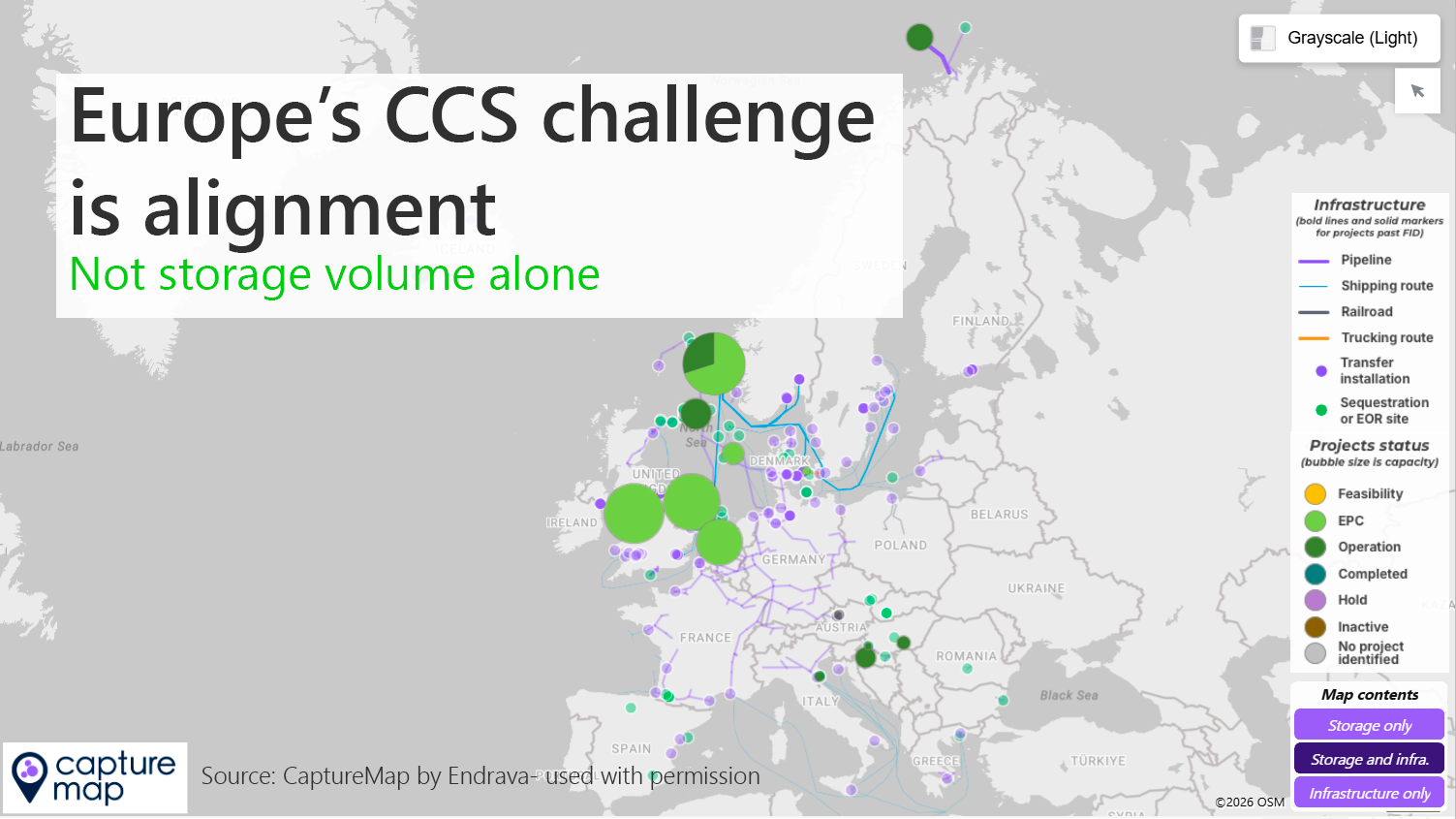
And new CaptureMap by Endrava analysis suggests that the CCS challenge is not simply “more storage”.
At an aggregated European level, 17 storage projects past FID represent 18.7 mtpa of CO₂ injection capacity, while 98 capture projects past FID represent 15.9 mtpa of capture capacity.
Storage locations do not always match emitter clusters. Transport timelines do not always move in step with capture projects.
So the harder question may not be volume alone.
It may be whether the right storage is available for the right emitters at the right time — and through value chains that are economically robust, not just politically acceptable.
For years, much of the European CCS discussion has assumed that long and complex chains could be made viable if enough support mechanisms were stacked around them.
That may still be true in some cases.
But it cannot be the only model.
Where geology allows, Europe should look much harder at:
– storage closer to the emitter
– more use of repurposed infrastructure
– lower transport dependence
– and better alignment between capture, transport and storage
This is not an argument against Norway.
And it is not an argument against cross-border CO₂ infrastructure.
Europe will still need shared networks and offshore storage.
But the next phase of CCS may be less about building the most politically comfortable chain — and more about building the most economically resilient one.
That is a debate worth having.
Can Europe afford long CCS chains?
Peter Kristensen, CO2 Hub Europe
